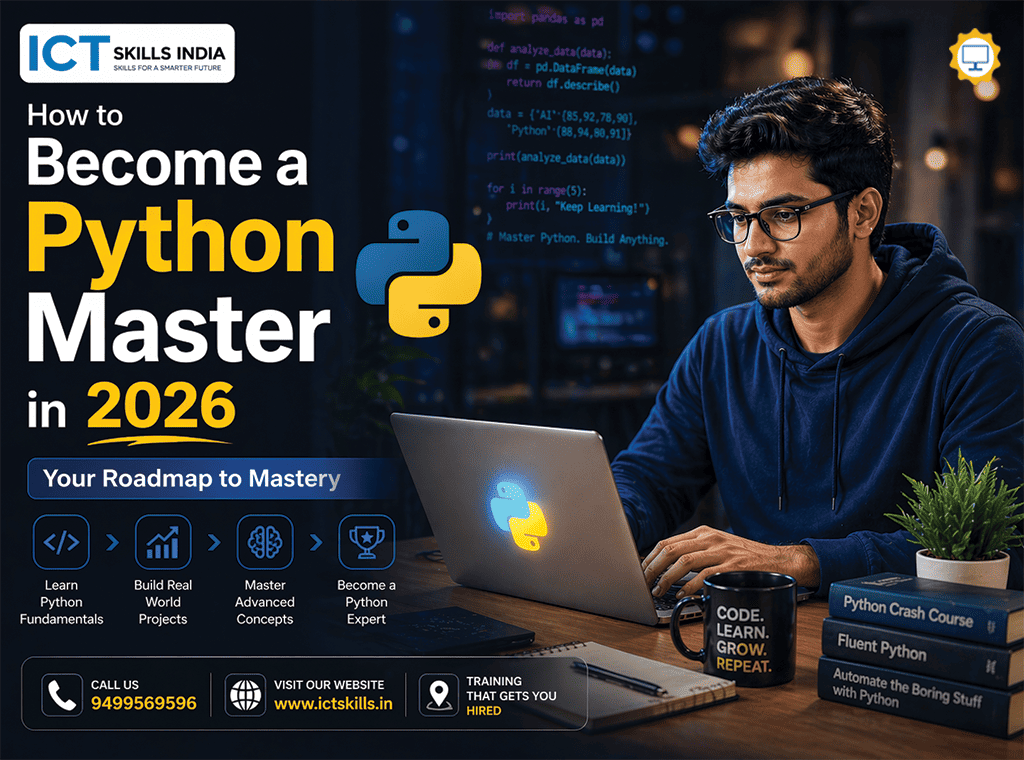
How to Become a Python Master in 2026?
Python is no longer just a programming language—it’s a career accelerator, a gateway to AI, and one of the most in-demand skills globally. If you’re aiming to become a Python master in 2026, you need more than just syntax knowledge—you need strategy, consistency, and real-world application.
This guide will walk you through a practical, human-centered roadmap to mastering Python, with insights inspired by training platforms like ICT Skills (India).
🚀 Why Python Mastery Matters in 2026?
Python continues to dominate industries such as:
- Data Science
- Artificial Intelligence
- Web Development
- Automation
- Cybersecurity
Its simplicity and versatility make it one of the most powerful tools for developers. According to industry trends, Python is widely used for building scalable applications, automating workflows, and solving real-world problems.
🧭 Step-by-Step Roadmap to Become a Python Master
-
Build a Strong Foundation
Before aiming for mastery, you must understand:
- Variables & Data Types
- Loops & Conditions
- Functions
- Lists, Tuples, Dictionaries
These fundamentals are covered in beginner-friendly training programs like those offered by ICT Skills, which emphasize hands-on coding and real-time interaction.
👉 Pro Tip: Don’t rush basics. Mastery begins with clarity.
-
Learn Object-Oriented Programming (OOP)
To write scalable and clean code, you must understand:
- Classes & Objects
- Inheritance
- Polymorphism
- Encapsulation
Advanced courses stress OOP as a core requirement for building large-scale applications.
-
Master Data Structures & Algorithms
Python mastery requires problem-solving ability. Focus on:
- Arrays & Linked Lists
- Stacks & Queues
- Trees & Graphs
- Sorting & Searching
These concepts help you crack coding interviews and improve efficiency.
-
Work on Real-World Projects
Learning theory isn’t enough. You must build:
- Web apps (Flask/Django)
- Automation scripts
- Data analysis projects
- APIs
Hands-on projects are a key feature of professional training platforms like ICT Skills, helping learners apply skills to real-world problems.
-
Explore Python Libraries & Frameworks
To become a master, you must go beyond core Python:
🔬 Data Science
- NumPy
- Pandas
- Matplotlib
🤖 Machine Learning
- Scikit-learn
- TensorFlow
🌐 Web Development
- Django
- Flask
Advanced training includes these tools to prepare learners for industry-level roles.
-
Learn Debugging & Testing
Professional developers don’t just write code—they fix and optimize it.
Focus on:
- Unit Testing
- Debugging tools
- Error handling
This is a critical part of advanced Python learning.
-
Understand Concurrency & Performance
To truly stand out:
- Learn multi-threading
- Use multiprocessing
- Optimize performance
These skills help you build high-performance applications.
-
Build a Portfolio
Your portfolio should include:
- GitHub projects
- Real-world applications
- Problem-solving examples
👉 Recruiters care more about what you build than what you know.
-
Join a Structured Training Program
Self-learning is powerful, but structured learning accelerates growth.
Platforms like ICT Skills offer:
- Live interactive sessions
- Industry-level projects
- Expert mentorship
- Certification
These elements significantly improve learning outcomes and job readiness.
-
Stay Updated with Trends
Python evolves constantly. In 2026, focus on:
- AI & Generative AI
- Automation tools
- Cloud integration
- Data engineering
🧠 Skills You Need to Become a Python Master
Technical Skills
- Core Python
- OOP
- Data Structures
- APIs
- Databases
Soft Skills
- Problem-solving
- Logical thinking
- Communication
- Continuous learning
⚠️ Common Mistakes to Avoid
- Skipping basics
- Not practicing enough
- Avoiding projects
- Learning without direction
- Ignoring debugging
⏳ How Long Does It Take?
Level | Time Required |
Beginner | 1–2 months |
Intermediate | 3–6 months |
Advanced | 6–12 months |
👉 With structured learning (like ICT Skills), you can accelerate this timeline.
💼 Career Opportunities After Mastering Python
- Python Developer
- Data Scientist
- Machine Learning Engineer
- AI Engineer
- Automation Engineer
Python expertise opens doors across multiple industries.
Becoming a Python master in 2026 is not about memorizing code—it’s about understanding concepts, building projects, and continuously evolving.
If you follow this roadmap:
- Learn consistently
- Practice daily
- Build real-world projects
- Join structured programs like ICT Skills
You won’t just learn Python—you’ll master it.
Start your Python journey today with expert-led training and real-world projects. Explore programs at ICT Skills and take your skills to the next level.
Tag:AI, Coding, Data Science, ICT Skills, Python, Python Developer, Tech Career
You may also like
How to Become a Data Analyst in 2026?
7 High-Demand Digital Skills Every Student Needs Now